
- Home /
- Our technologies
Our technologies
Advanced water treatment powered by selective chemistry
Chromafora offers technologies that remove PFAS and metals from complex water streams – and recover valuable resources in the process.
Every solution is built around one idea: selectivity. By targeting exactly what needs to be removed, we treat even the most demanding water streams efficiently, with less waste and lower long-term cost.
Three technologies. Different challenges.
One selective approach.
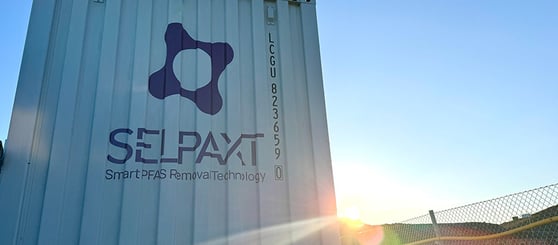
SELPAXT.
Advanced PFAS removal
For the most demanding PFAS challenges – including long-, short- and ultra-short-chain compounds – SELPAXT combines proprietary chemistry with ultrafiltration, concentrating PFAS into a residual stream as small as 0.1% of the treated volume.
PFAS Flocculation.
A simpler way to remove PFAS
For highly contaminated, complex water such as landfill leachate, flocculation offers a practical, lower-cost route to PFAS removal – up to 95%, using equipment your team already knows how to run.
SELMEXT.
Selective metal extraction
SELMEXT selectively separates metals from water and hydrometallurgical process streams – removing what's unwanted, recovering what has value. Current development spans gold, uranium, scandium and mercury.
We can also offer...
Not every water stream needs a purpose-built selective technology. For simpler polishing needs – or where a conventional method is genuinely the right fit – we also provide granular activated carbon (GAC) and ion exchange (IX) systems, either standalone or as a polishing step after SELPAXT or flocculation.
Granular Activated Carbon (GAC)
A familiar, well-proven adsorption technology for long-chain PFAS – well suited as a polishing step after a primary PFAS-selective treatment stage.
Ion Exchange
Resins
Higher-selectivity adsorption media that can improve removal of certain short-chain PFAS – offered standalone or integrated into a broader treatment train.
Different challenges. One selective approach.
PFAS and metals behave differently in water. That's why our technologies are designed around the specific contaminant, water matrix and treatment objective – combining proprietary chemistry with established separation processes to remove what matters while reducing unnecessary waste.
|
Technology |
PFAS chain-length coverage |
Residual waste |
Sensitivity in complex leachate |
Best fit |
|
SELPAXT™ (SAMF) |
Long, short & ultra-short – up to 99.7% removal demonstrated |
Very low – as little as ~0.1% of treated volume |
Low sensitivity to TOC and pH swings |
High-strength, complex leachate; demanding or tightening discharge limits |
|
PFAS Flocculation |
Long- and short-chain – up to 95% removal |
Moderate – dewatered sludge for disposal |
Can be used to pre-treat high-DOC water |
Cost-sensitive sites; pretreatment ahead of a polishing step |
|
Reverse Osmosis |
Broad-spectrum, high overall removal |
High – 15–30% concentrated reject stream |
Prone to fouling from salts, metals and organics |
Sites with an established plan for concentrate destruction |
|
Ion Exchange Resins |
Long-chain; improved removal of some short-chain PFAS |
Low media volume, but regeneration can generate brine/secondary waste |
Fouls with high chloride and organic loading |
Polishing step, or simpler matrices with lower fouling risk |
|
Granular Activated Carbon |
Long-chain; limited affinity for short- and ultra-short-chain PFAS |
Spent carbon requiring replacement/incineration |
Reduced adsorption efficiency in high-DOC matrices |
Polishing step, or simpler streams dominated by long-chain PFAS |
Technology insights