
- Home /
- SELPAXT PFAS Removal Technology
Advanced PFAS removal for complex water
Designed for the PFAS that are hardest to remove
Conventional adsorption technologies – such as activated carbon or ion exchange – can struggle with shorter PFAS compounds, and gradually lose capacity as their media becomes saturated.
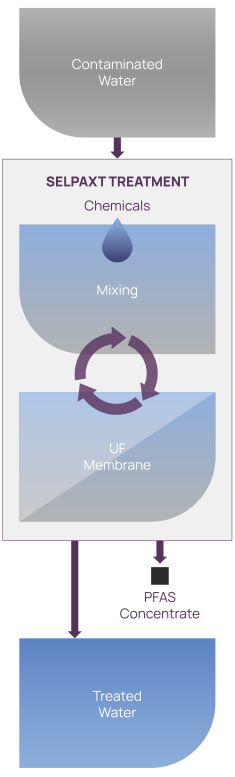
SELPAXT takes a different approach. Selective chemistry binds PFAS before separation by ultrafiltration, and the system regenerates automatically rather than relying on a fixed bed of media that wears out – enabling continuous treatment across a broad range of PFAS chain lengths.
How SELPAXT works
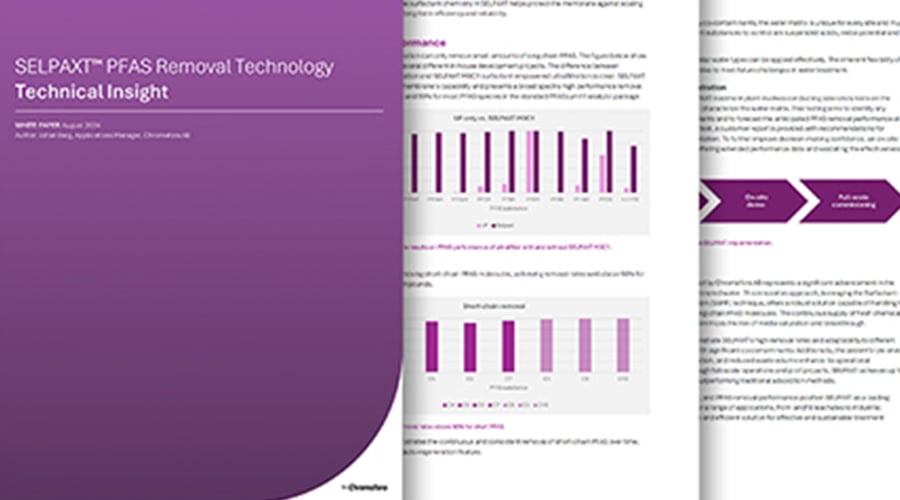
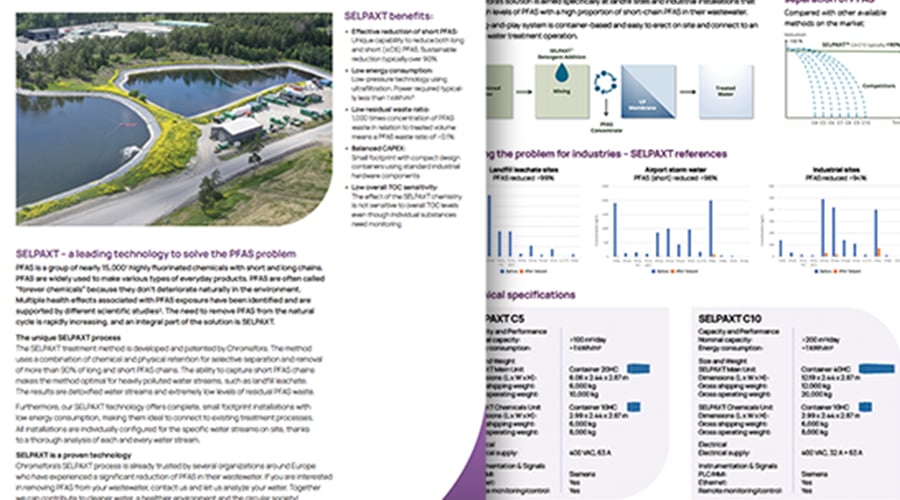
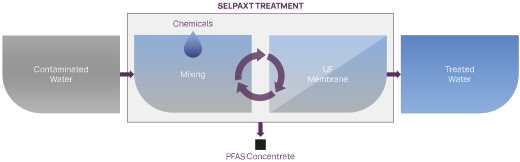
SELPAXT is based on Surfactant-Ligand Assisted Membrane Filtration (SAMF).
Proprietary chemistry selectively interacts with PFAS in the incoming water. The PFAS-containing structures are then separated using optimised ultrafiltration membranes.
Automatic regeneration enables continuous treatment, while remote monitoring helps maintain stable performance over time.
The SELPAXT process
Why SELPAXT?
Long, short
and ultra-
short PFAS
and ultra-
short PFAS
Minimal
residual
waste
residual
waste
Built for complex
water
water
Continuous
and reliable operation
SELPAXT.
Advanced PFAS removal
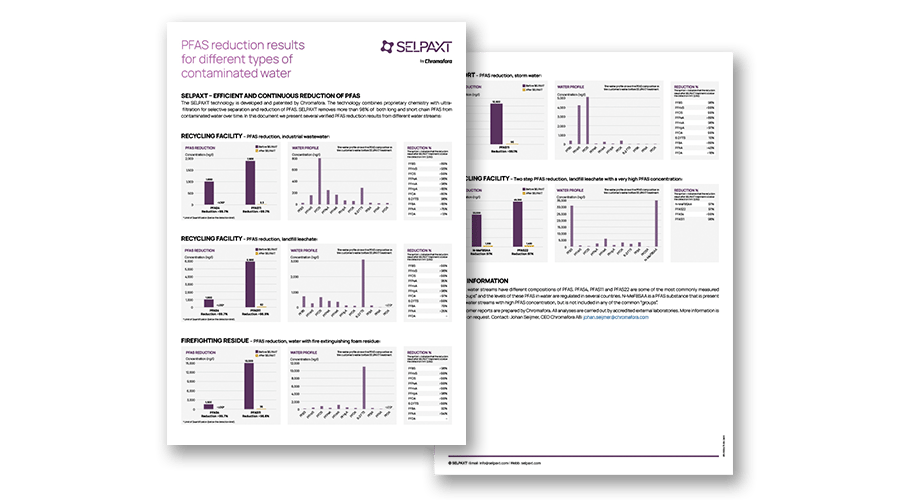
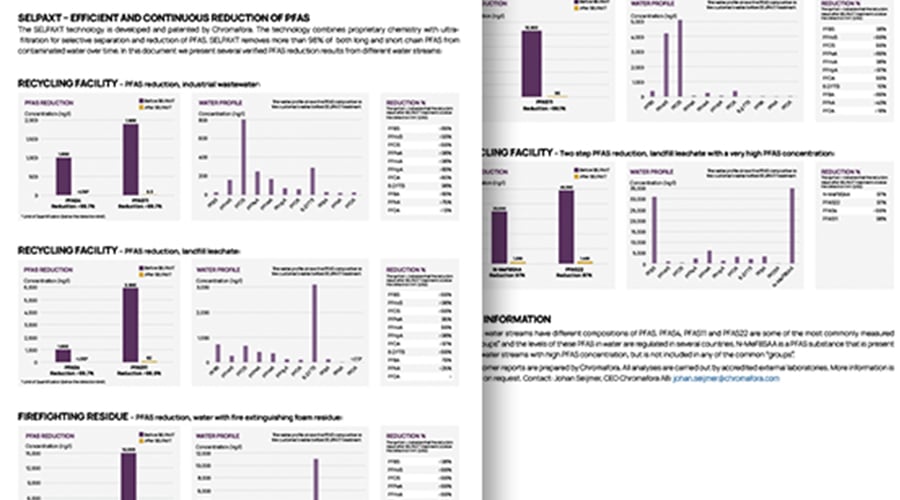
For the most demanding PFAS challenges – including long-, short- and ultra-short-chain compounds – SELPAXT combines proprietary chemistry with ultrafiltration, concentrating PFAS into a residual stream as small as 0.1% of the treated volume.
PFAS Flocculation.
A simpler way to remove PFAS
For highly contaminated, complex water such as landfill leachate, flocculation offers a practical, lower-cost route to PFAS removal – up to 95%, using equipment your team already knows how to run.
SELMEXT.
Selective metal extraction
SELMEXT selectively separates metals from water and hydrometallurgical process streams – removing what's unwanted, recovering what has value. Current development spans gold, uranium, scandium and mercury.
We can also offer...
Not every water stream needs a purpose-built selective technology. For simpler polishing needs – or where a conventional method is genuinely the right fit – we also provide granular activated carbon (GAC) and ion exchange (IX) systems, either standalone or as a polishing step after SELPAXT or flocculation.
Granular Activated Carbon (GAC)
A familiar, well-proven adsorption technology for long-chain PFAS – well suited as a polishing step after a primary PFAS-selective treatment stage.
Ion Exchange
Resins
Higher-selectivity adsorption media that can improve removal of certain short-chain PFAS – offered standalone or integrated into a broader treatment train.
Different challenges. One selective approach.
PFAS and metals behave differently in water. That's why our technologies are designed around the specific contaminant, water matrix and treatment objective – combining proprietary chemistry with established separation processes to remove what matters while reducing unnecessary waste.
Which technology fits your water?
PFAS chain length, water chemistry and your discharge target all influence which treatment approach makes sense. The table below summarises how our core technologies – and the additional technologies we also offer – compare on the factors that matter most in complex water streams such as landfill leachate.
|
Technology |
PFAS chain-length coverage |
Residual waste |
Sensitivity in complex leachate |
Best fit |
|
SELPAXT™ (SAMF) |
Long, short & ultra-short – up to 99.7% removal demonstrated |
Very low – as little as ~0.1% of treated volume |
Low sensitivity to TOC and pH swings |
High-strength, complex leachate; demanding or tightening discharge limits |
|
PFAS Flocculation |
Long- and short-chain – up to 95% removal |
Moderate – dewatered sludge for disposal |
Can be used to pre-treat high-DOC water |
Cost-sensitive sites; pretreatment ahead of a polishing step |
|
Reverse Osmosis |
Broad-spectrum, high overall removal |
High – 15–30% concentrated reject stream |
Prone to fouling from salts, metals and organics |
Sites with an established plan for concentrate destruction |
|
Ion Exchange Resins |
Long-chain; improved removal of some short-chain PFAS |
Low media volume, but regeneration can generate brine/secondary waste |
Fouls with high chloride and organic loading |
Polishing step, or simpler matrices with lower fouling risk |
|
Granular Activated Carbon |
Long-chain; limited affinity for short- and ultra-short-chain PFAS |
Spent carbon requiring replacement/incineration |
Reduced adsorption efficiency in high-DOC matrices |
Polishing step, or simpler streams dominated by long-chain PFAS |
Technology insights